David Tennant, best known for playing The Doctor in Dr. Who & for portraying Barty Crouch Jr. in Harry Potter, is an accomplished stage actor. PBS hosts the film version of the stage performance of Hamlet.
Watch the Film
Also, in the genre-bending performance category, Anna Deavere Smith's TED performance bridges the gap between a play and a film, as the performance takes place on a stage, in front of a large number of people, but that there is also a camera that takes close-ups images of her while she is performing.
Anna Deavere Smith: Four American characters | Video on TED.com
Do you classify these more as film pieces or a theater pieces? What elements of the performances make you feel this way? How do these elements make the performances work or not work for you?

#1 On-Camera Acting Studio for the Learning and Creating of Emotions and Emotional Expression.| The Only Acting Studio Where the Science of Emotion Meets Artistic Expression.
July 31, 2011
July 29, 2011
"It has taken me all these years to learn to do nothing on screen..."
Some experienced actors will make statements along the lines of, "It has taken me all these years to learn to do nothing on screen - I just think it."
Young actors, reading this, joyfully rush in to do the same and find to their horror that their performances don't exist, they are invisible. This is because the experienced actor now puts her thoughts onto her face without realizing it, and thinks she is doing nothing.
- Patrick Tucker's "Secrets of Screen Acting" 2nd edition
Young actors, reading this, joyfully rush in to do the same and find to their horror that their performances don't exist, they are invisible. This is because the experienced actor now puts her thoughts onto her face without realizing it, and thinks she is doing nothing.
- Patrick Tucker's "Secrets of Screen Acting" 2nd edition


From Stage to Screen...I read some really bad advice online...
I was looking for a quote from a famous actor on the nature of film acting vs. stage acting, but I gave into curiosity and Googled "quote about the difference between acting on stage and acting in film"...the first option was a Yahoo Answers page where people are just repeating myths like "On stage, act with your body; on film, act with your eyes" ...and my personal favorite: "The camera reads your mind."
REALLY? That last one was chosen as the best answer! I knew we had an uphill battle, but nobody said anything about moving your facial muscles. Nobody?
http://answers.yahoo.com/question/index?qid=20080313223523AAmPMS0
What advice do you have for someone transitioning from stage to screen?
REALLY? That last one was chosen as the best answer! I knew we had an uphill battle, but nobody said anything about moving your facial muscles. Nobody?
http://answers.yahoo.com/question/index?qid=20080313223523AAmPMS0
What advice do you have for someone transitioning from stage to screen?
July 27, 2011
Jodi Foster in Contact
Jodie Foster is the master of economic facial gestures that tell you everything you need to know.
Do you feel that a stage performance of Contact would have been able to communicate this efficiently? How would she need to change her style of performing to communicate this many emotions, while strapped into a chair? Or do you feel that this scene is not well-suited to stage?
Do you feel that a stage performance of Contact would have been able to communicate this efficiently? How would she need to change her style of performing to communicate this many emotions, while strapped into a chair? Or do you feel that this scene is not well-suited to stage?
July 26, 2011
July 25, 2011
Myth #2 Film acting is a matter of making what you do on stage smaller.
What happens on your face truly defines the difference between stage and film acting.
Are you one of the many actors who have walked out of an audition after a casting director kept insisting you make what you were doing smaller and smaller until it all finally disappeared and thought, “I guess film acting is about doing nothing’. To be sure, on-camera acting is not about doing nothing. Nothing looks like nothing. Nothing doesn’t look like fear, anger or any of the other emotions actors are asked to project...
The biggest difference between on-camera and stage acting isn't just where the audience is or how small you try to make your acting, it's how we communicate emotion.
Do you know what and how your face communicates? Most actors don’t. The language the face speaks is different than the language the body speaks. The research has taught us that the body tells us how well we are coping with an emotion. This is how emotion is read on stage. The face is the source by which we read what you feel. This is how it’s read for the medium and close-up shot of film.
Working on stage, actors don’t really need to be concerned as much about the subtleties of facial emotion for the simple reason, most of the time, the audience can’t see your face clearly enough.
In conclusion, on-camera acting is not about making what you would do on stage smaller, it’s about a different set of tools.
To have a successful career in front of the camera you have to learn the nature and experiences of an of emotions, what they look like on your face and how to trigger and manage them. We are in the emotional communication business after all. What happens on your face truly defines the difference between stage and film acting.
Are you one of the many actors who have walked out of an audition after a casting director kept insisting you make what you were doing smaller and smaller until it all finally disappeared and thought, “I guess film acting is about doing nothing’. To be sure, on-camera acting is not about doing nothing. Nothing looks like nothing. Nothing doesn’t look like fear, anger or any of the other emotions actors are asked to project...
The biggest difference between on-camera and stage acting isn't just where the audience is or how small you try to make your acting, it's how we communicate emotion.
Do you know what and how your face communicates? Most actors don’t. The language the face speaks is different than the language the body speaks. The research has taught us that the body tells us how well we are coping with an emotion. This is how emotion is read on stage. The face is the source by which we read what you feel. This is how it’s read for the medium and close-up shot of film.
Working on stage, actors don’t really need to be concerned as much about the subtleties of facial emotion for the simple reason, most of the time, the audience can’t see your face clearly enough.
In conclusion, on-camera acting is not about making what you would do on stage smaller, it’s about a different set of tools.
To have a successful career in front of the camera you have to learn the nature and experiences of an of emotions, what they look like on your face and how to trigger and manage them. We are in the emotional communication business after all. What happens on your face truly defines the difference between stage and film acting.
July 16, 2011
Myth #1: "It's all in the eyes.": Meet Your Eyebrows...Part 2
Although we we’ll be talking about other emotional muscle groups in the face and how they communicate emotion, right now I would like to hang on the eyebrows a bit longer. Here are some more award winning actors who understand the power of the eyebrows. Not to say that they are moving them consciously, but certainly they are not preventing them from doing so.
As you look at each of these photos try to image what they would look like if only the eyes were involved. Would they be as powerful? Look at each photo, but bring focus to what the brows are doing and how it helps the viewer understand or interpret what the actor is feeling or thinking.

Look at Tom Hanks in “Castaway”, without his eyebrows positioned the way they are, would you still feel the loss and worry he was experiencing when he lost ‘Wilson’?


Looking at each of the photos, you see that the actor’s eyes are focused in on something. We, the audience are drawn to what they are focused on. But when we look closer, it’s actually what’s happening around the eyes in these photos...it’s the eyebrows and, to a certain degree even, the mouth that communicate to the audience what emotion the actor is actually experiencing.
As you look at each of these photos try to image what they would look like if only the eyes were involved. Would they be as powerful? Look at each photo, but bring focus to what the brows are doing and how it helps the viewer understand or interpret what the actor is feeling or thinking.

Look at Tom Hanks in “Castaway”, without his eyebrows positioned the way they are, would you still feel the loss and worry he was experiencing when he lost ‘Wilson’?


Looking at each of the photos, you see that the actor’s eyes are focused in on something. We, the audience are drawn to what they are focused on. But when we look closer, it’s actually what’s happening around the eyes in these photos...it’s the eyebrows and, to a certain degree even, the mouth that communicate to the audience what emotion the actor is actually experiencing.
July 15, 2011
Myth #1: "It's all in the eyes.": Meet Your Eyebrows...
Continuing on the myth that it’s all in the eyes, I would like to introduce the eyebrows into the conversation. So often I hear people in the industry tell actors that if they want a successful on-camera career they better learn how to keep their eyebrows from moving.
Apparently, no one told these actors:
Shemar Moore

Thomas Gibson

Joe Mantegna

Ice T & B. D. Wong

James Todd Smith, a.k.a. LL Cool J

Donnie Wahlberg

Mariska Hargitay & Christopher Meloni

USAGE AND MEANING OF THE BROWS:
Eliminating the brow from your acting is like taking taking notes out of a musical scale. Yes you can still come up with a melody but you will be limited.
We use the eyebrows to communicate so much. They get drawn in and down when we are determined, concentrated, focused, confused or perplexed. They lift up and arch when we are surprised, questioning or doubting someone or something. The inner corners of the brow lift when we are feeling sad, helpless or longing for something. They lift up slightly and pull together when we are worried, concerned or apprehensive about something. We also use them when we are beginning to get angry or frightened. We even use them to say hello with.
Without saying a word, the brows by themselves, can communicate all of this. Why would you want to eliminate one of your greatest tools for non-verbal communication?
If you see yourself working as a detective on one of the crime dramas you may want to rethink how you use your brows.
Apparently, no one told these actors:
Shemar Moore

Thomas Gibson

Joe Mantegna

Ice T & B. D. Wong

James Todd Smith, a.k.a. LL Cool J

Donnie Wahlberg

Mariska Hargitay & Christopher Meloni

USAGE AND MEANING OF THE BROWS:
Eliminating the brow from your acting is like taking taking notes out of a musical scale. Yes you can still come up with a melody but you will be limited.
We use the eyebrows to communicate so much. They get drawn in and down when we are determined, concentrated, focused, confused or perplexed. They lift up and arch when we are surprised, questioning or doubting someone or something. The inner corners of the brow lift when we are feeling sad, helpless or longing for something. They lift up slightly and pull together when we are worried, concerned or apprehensive about something. We also use them when we are beginning to get angry or frightened. We even use them to say hello with.
Without saying a word, the brows by themselves, can communicate all of this. Why would you want to eliminate one of your greatest tools for non-verbal communication?
If you see yourself working as a detective on one of the crime dramas you may want to rethink how you use your brows.
July 14, 2011
July 13, 2011
Here's something fun - watch Michael Caine's "Art of not blinking..."
Although I think this is an interesting take on whether to blink or not blink as an acting technique, excessive blinking is often a way the body expresses some form of stress. For an actor, the stress can be coming from what they are emotionally creating (as a character) or unable to create (personally). Closing your eyes, or blinking, repeatedly can also be like a mini escape from what is happening. When we lie, we tend to blink more than when we are focused and committed. As an acting coach I see this a lot. When an actor loses focus, the blinking intensifies.
July 12, 2011
Myth #1: "It's all in the eyes.": Oh, reeeaaally?
Not that much happens in the eyes, with regard to emotion: "The iris is a muscle that expands and contracts to control pupil size. The pupil enlarges in dimmer lighting and grows smaller in brighter lighting. The pupil also shrinks when you focus on near objects, such as a book you are reading. When the pupil size changes, the pigments in the iris compress or spread apart, changing the eye color a bit.
Certain emotions can change both the pupil size and the iris color. That's why some people say their eyes change colors when they're angry or loving."
(Excerpt from here: http://www.allaboutvision.com/conditions/eye-color.htm)
Certain emotions can change both the pupil size and the iris color. That's why some people say their eyes change colors when they're angry or loving."
(Excerpt from here: http://www.allaboutvision.com/conditions/eye-color.htm)
July 11, 2011
If it's All About the Eyes, Then Why Do Eddie Murphy's Eyebrows Do His Acting?
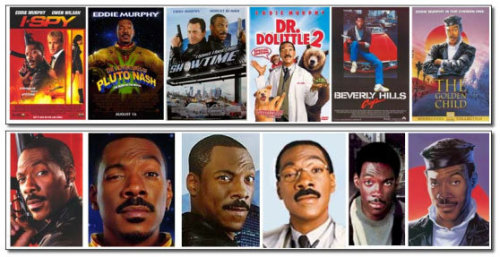 Seriously, I thought this article would be a joke, but then I discovered that Eddie Murphy has been playing the same type of character since he started acting…
http://www.cracked.com/article_19093_8-actors-who-look-exactly-same-every-movie-poster.html?wa_user1=1&wa_user2=Movies+%26+TV&wa_user3=article&wa_user4=recommended
July 10, 2011
Myth #1: "It's all in the eyes.": You Can’t Push An Emotion Through your Eyeballs
The eyes are the windows to the soul. We've all heard it. I heard a photographer pleading for the actor to bring it to their eyes. I also heard of acting teachers trying in vain to get an actor to create an emotion and push it through their eyes. I heard a casting director tell me that all good acting is in the eyes.
The reality is you can’t push an emotion through your eyes.
Let’s think logically about it for a moment. Do your eyes ever feel sad? Have they ever gotten angry? Have they ever woken you up in the middle of the night saying "damn, I’m mad?" The answer is no. When it comes to the eyes, the pupils can dilate or contract. Your eyes can move left to right, up and down, around in circles. They may get wet or dry, but that could also be allergies.
If you are resisting an emotion tension may build up pressure behind the eyes, causing them to bulge a little, but it’s pressure you feel, not emotion.
Both the moist and the bulging eyes make it seem as though something is going on with you to the viewer, but it’s more of the resistance or managing of an emotion rather than the reveal of one. So the question is, if it’s not all in the eyes, where is it?
The answer is, it’s in different parts of the face. Although we may focus on someone’s eyes, we are taking in more information than we realize. Our peripheral vision picks up the slight opening and dropping of the mouth or the eyebrow being drawn together. We are actually reading different parts of the face, including the eyelids while looking at the eyes and then determining what that person is feeling. Moving one muscle on your face in one of the emotional families changes the whole look of your face, making it look like it's all in the eyes.
You can't force an emotion through your eyes. That is why it can be so devastating to the actor's acting process because everyone is telling them to "Bring it to the eyes; bring it to the eyes." In frustration you try to push out the emotion, but you never quite achieve the result you want.
----
Sound familiar?
The reality is you can’t push an emotion through your eyes.
Let’s think logically about it for a moment. Do your eyes ever feel sad? Have they ever gotten angry? Have they ever woken you up in the middle of the night saying "damn, I’m mad?" The answer is no. When it comes to the eyes, the pupils can dilate or contract. Your eyes can move left to right, up and down, around in circles. They may get wet or dry, but that could also be allergies.
If you are resisting an emotion tension may build up pressure behind the eyes, causing them to bulge a little, but it’s pressure you feel, not emotion.
Both the moist and the bulging eyes make it seem as though something is going on with you to the viewer, but it’s more of the resistance or managing of an emotion rather than the reveal of one. So the question is, if it’s not all in the eyes, where is it?
The answer is, it’s in different parts of the face. Although we may focus on someone’s eyes, we are taking in more information than we realize. Our peripheral vision picks up the slight opening and dropping of the mouth or the eyebrow being drawn together. We are actually reading different parts of the face, including the eyelids while looking at the eyes and then determining what that person is feeling. Moving one muscle on your face in one of the emotional families changes the whole look of your face, making it look like it's all in the eyes.
You can't force an emotion through your eyes. That is why it can be so devastating to the actor's acting process because everyone is telling them to "Bring it to the eyes; bring it to the eyes." In frustration you try to push out the emotion, but you never quite achieve the result you want.
----
Sound familiar?
July 9, 2011
Distortion Plays Into How People Percieve Emotions...
Interesting page on Japanese vs. Dutch methods of perceiving emotions, Japanese compensate for distortion of masked anger by paying more attention to the voice than the facial expressions...the muscles are universal, but the distortions are culture specific: http://www.psychologicalscience.org/index.php/news/releases/perception-of-emotion-is-culture-specific.html
Remember that as actors, there are lots of tools at our disposal...you can disconnect the voice from the facial reactions, if the piece calls for it.
Remember that as actors, there are lots of tools at our disposal...you can disconnect the voice from the facial reactions, if the piece calls for it.
July 8, 2011
Why Speaking the Language of the Face is Different from Reading It
Most of us understand this language, when we see it. Without saying a word, most of us are able to pick up facial cues from others that tell us if they’re upset or frightened or feeling sad. This is why it looks like good film and TV actors are doing so little, yet you know what they feel and think.
But reading and speaking it are two different things. Like any other language, if we give a certain word more emphasis or the wrong inflection or use the wrong word, it is very difficult to be understood.
So often in film and television, we see these beautiful subtle moments – with a subtle change in the face we know they have taken in new information. Without any words spoken, we know all this, this is how the Language the Face speaks. When you speak this language clearly it looks like life. The more skilled you are, the easier it looks. In fact, it looks like you aren’t doing anything. So most actors fall into the belief that film acting is about doing nothing, which couldn’t be further from the truth...
But reading and speaking it are two different things. Like any other language, if we give a certain word more emphasis or the wrong inflection or use the wrong word, it is very difficult to be understood.
So often in film and television, we see these beautiful subtle moments – with a subtle change in the face we know they have taken in new information. Without any words spoken, we know all this, this is how the Language the Face speaks. When you speak this language clearly it looks like life. The more skilled you are, the easier it looks. In fact, it looks like you aren’t doing anything. So most actors fall into the belief that film acting is about doing nothing, which couldn’t be further from the truth...
July 6, 2011
Distortion: President Bush and the Permanent Case of "I Just Heard the Best Dirty Joke..."
President Bush smirks his way through an interview about serious topics. Actors, it's this type of distortion that can make you seem not right for the part.
July 5, 2011
Distortions: Your Impulses May Just Cost You The Job
Ever wonder why what you create sometimes doesn't always appear on your face the same way as you thought it would? Can this distortion or discrepancy between what you feel and what you reveal cost you a callback or even the job? You bet it can.
We already talked about how we are wired to express, the internalizers (introverts) and externalizers (extroverts). We also talked about cultural display rules*, for example, in middle America most men are taught to manage the appearance of fear and women of anger.
Another set of display rules that can challenge how we express emotions that we are trying to create are personal display rules*. Basically, personal display rules are the rules we learned growing up from our own family. They are the result of our family’s idiosyncrasies.
Growing up, have you ever heard, "take that look of your face, right now" or "don't look at me like that young man". How about,” smile at the nice man"? So, as a kid you learned the rule and you smile at the nice man. Now as an adult, you may still be smiling at the nice man, whether you feel it or not. Sometimes you may know you’re smiling, but a lot of the time, you don’t. Sometimes you can’t stop smiling.
These often unconsciously expressed display rules, be they personal, cultural or due to our wiring are called distortions.
You may be carrying many of those rules or what you can and can not express with you into your audition and they can cost you the job because you are feeling one thing and unconsciously expressing another. For example, you may want to express anger but your face is smiling or it says nothing. They want fear but you are giving them anger and so on.
If our job as actors, is to communicate recognizable and appropriate reactions and it all starts with how we personally express. Any distortions may cost you the job. Think about your rules.
Do you find yourself expressing emotion differently the your actor friend around you? Yes, your rules make you uniquely you, but your inability to give what is asked of you can put you at a serious disadvantage.
*Term coined and defined by Paul Ekman and Wallace Friesen
We already talked about how we are wired to express, the internalizers (introverts) and externalizers (extroverts). We also talked about cultural display rules*, for example, in middle America most men are taught to manage the appearance of fear and women of anger.
Another set of display rules that can challenge how we express emotions that we are trying to create are personal display rules*. Basically, personal display rules are the rules we learned growing up from our own family. They are the result of our family’s idiosyncrasies.
Growing up, have you ever heard, "take that look of your face, right now" or "don't look at me like that young man". How about,” smile at the nice man"? So, as a kid you learned the rule and you smile at the nice man. Now as an adult, you may still be smiling at the nice man, whether you feel it or not. Sometimes you may know you’re smiling, but a lot of the time, you don’t. Sometimes you can’t stop smiling.
These often unconsciously expressed display rules, be they personal, cultural or due to our wiring are called distortions.
You may be carrying many of those rules or what you can and can not express with you into your audition and they can cost you the job because you are feeling one thing and unconsciously expressing another. For example, you may want to express anger but your face is smiling or it says nothing. They want fear but you are giving them anger and so on.
If our job as actors, is to communicate recognizable and appropriate reactions and it all starts with how we personally express. Any distortions may cost you the job. Think about your rules.
Do you find yourself expressing emotion differently the your actor friend around you? Yes, your rules make you uniquely you, but your inability to give what is asked of you can put you at a serious disadvantage.
*Term coined and defined by Paul Ekman and Wallace Friesen
July 4, 2011
It's all in the eyes: Myth or Fact?
There seems to be a lot of controversy, a lot of casting directors, acting coaches & photographers saying “It’s all in the eyes.” Is this a myth or a fact? Let us know, do you think it’s a myth, a fact or are you undecided?
Happy Birthday, America...Today Brings Us Toddlers & Tiaras.
In honor of the 4th of July, let's take a look at some of the scariest examples of people who distort their emotions: the kids from Toddlers and Tiaras
Eden Wood has a habit of smiling (which generally makes your eyes close a bit) with her eyes wide open... Wide open eyes while smiling looks creepy as really open eyes can be a sign of fear...
Eden Wood has a habit of smiling (which generally makes your eyes close a bit) with her eyes wide open... Wide open eyes while smiling looks creepy as really open eyes can be a sign of fear...
July 3, 2011
July 2, 2011
Marina Abramovic Made Me Cry
Sometimes we see something that makes all of the personal rules we have go out the window. For many art gallery visitors, Marina Abramovic's piece, where she sat at the other end of a table and looked at the other person, created enough intimacy to forgo all the rules. There is a photo gallery here: http://marinaabramovicmademecry.tumblr.com/
July 1, 2011
Community Involvement Friday: Personal Display Rules
Let us know what emotion is difficult for you to show to your family, friends and the public in general, and why.
Subscribe to:
Posts (Atom)